Quick Answer
-
Oqood is the Arabic word for "contracts" and refers to the DLD's system for registering off-plan property sales in Dubai's Interim Property Register
-
The developer — not the buyer — applies for Oqood registration through the DLD's Oqood portal within 90 days of the sale and purchase contract being signed
-
The buyer pays 2% of the sale value as a registration fee, and the seller (developer) also pays 2%
-
Once registered, the DLD issues an Oqood e-certificate to the buyer by email — this is your legal proof of ownership until the title deed is issued
-
Under Article 3(1) of Dubai Law No. 13 of 2008, any off-plan sale not recorded in the Interim Property Register is void
Buying off-plan property in Dubai means you are purchasing a unit that does not yet physically exist, or is not yet complete. That raises an obvious question: what proof do you have that the property is yours? The answer is Oqood registration. It is the legal mechanism that records your purchase in the Dubai Land Department's official register before the building is finished, and it carries real legal force under Dubai law.
For Australian buyers purchasing off-plan in Dubai, understanding Oqood is not optional — it is the foundation of your ownership rights from the day you sign until the day you receive your title deed.
This guide explains exactly what Oqood registration is, how it works, what it costs, and what protections it gives you as a buyer.
What Oqood Registration Means
The word and the law
Oqood (عقود) is the Arabic word for "contracts." In Dubai property, the term refers specifically to the Dubai Land Department's system for recording off-plan sales before a building is complete.
The legal basis for Oqood registration is Dubai Law No. 13 of 2008 on Initial Real Estate Registration. Article 2 of that law defines the Interim Property Register as the Land Department's record where off-plan sale contracts and other off-plan dispositions are logged before they move to the main Property Register.
Article 3(1) of the same law states plainly that an off-plan transaction that transfers or restricts ownership "will be void unless entered in that Register." There is no grey area here. An off-plan sale that has not been registered through Oqood has no legal standing.
Why it exists
Before Law No. 13 of 2008 came into effect, Dubai's off-plan market had no formal mechanism to record a buyer's interest in an uncompleted unit. A buyer could sign a sale and purchase agreement but have no official registration to protect that interest. Oqood changed that. It created a government-maintained record of every off-plan sale, giving buyers a legally recognised ownership position during the construction period.
Who manages it
The Dubai Land Department manages Oqood registration through its Oqood portal, also called the Real Estate Developers Portal. RERA (the Real Estate Regulatory Authority), which sits within the DLD, oversees regulatory compliance for the process.
Who Applies for Oqood Registration
The developer, not the buyer
This is one of the most important things to understand about Oqood. The buyer does not apply for registration. The developer applies through the DLD's Oqood portal on the buyer's behalf.
Under the DLD's Request to Register the Initial Sale eService, the developer logs into the portal, selects the property, enters the buyer's details, attaches the required documents, and submits the application. The DLD then issues the Oqood e-certificate and sends it to the purchaser by email.
Your role as the buyer is to ensure you have received that certificate after signing your sale and purchase agreement. If weeks pass with no certificate, contact your developer and ask for confirmation that registration has been submitted.
The 90-day rule
The DLD's eService page confirms that the sale and purchase contract must be registered in the Interim Property Register within 90 days of the signing date. This is a legal deadline, not a guideline. Under Article 3(1) of Law No. 13 of 2008, an unregistered transaction is void, which means that if a developer fails to register within 90 days, your purchase has no legal protection until registration occurs.
If you are buying off-plan from Australia and you have signed your SPA remotely, start tracking from that signing date. If you have not received your Oqood certificate within a few weeks of signing, follow up with your developer.
What the developer submits
The DLD eService page lists the documents the developer submits on behalf of individual buyers. For a non-resident individual (which covers most Australian buyers), those are a copy of the signed sale and purchase contract, a copy of a valid UAE ID (if the buyer has one), and a copy of a valid passport for non-residents.
If the buyer is a company rather than an individual, additional documents apply depending on the company structure, including trade licenses, memoranda of association, and notarised translations.
The Oqood Fees
What you pay as the buyer
The DLD's eService page confirms the following fees for Oqood registration. These are the figures as stated by the DLD directly.
The following table shows the fees confirmed on the DLD's Request to Register the Initial Sale eService.
|
Fee |
Who Pays |
Amount |
|
Registration fee — buyer |
Purchaser |
2% of the sale value |
|
Registration fee — seller |
Developer/Seller |
2% of the sale value |
|
Knowledge fee |
Purchaser |
AED 10 |
|
Innovation fee |
Purchaser |
AED 10 |
|
Developer portal registration fee |
Developer |
AED 1,000 |
The buyer's share is 2% of the sale value plus AED 20 in knowledge and innovation fees. This is paid at the point of registration, not at the point of signing your SPA.
As a practical example: if you are purchasing an off-plan apartment at AED 1,000,000, your Oqood registration fee is AED 20,000 plus AED 20, totalling AED 20,020. The developer pays the same 2% on top of that.
This 2% buyer fee is separate from and additional to the 4% DLD transfer fee that applies when the property is completed and registered with a full title deed. The Oqood fee covers the initial registration only. You can read more about what DLD fees apply when buying property in Dubai in our dedicated fee guide.
How the fee is paid
The DLD's eService page confirms that payment is made through the Oqood portal via Noqodi wallet, or by deduction from the project's escrow account. As a buyer, you will typically pay your 2% to the developer, and the developer handles the submission through the portal. Confirm with your developer exactly how and when this payment is collected before you sign.
What You Receive: The Oqood Certificate
The e-certificate
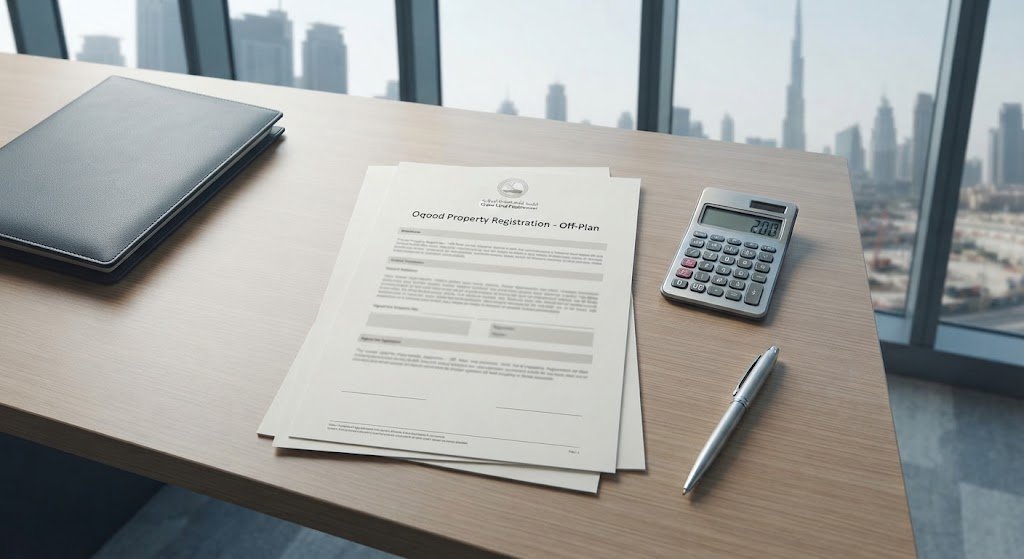
Once the developer submits the registration and it is approved, the DLD issues a provisional registration e-certificate. This is the Oqood certificate. The DLD sends it to the purchaser by email, as confirmed on the eService page.
This certificate is your legal proof of ownership of the off-plan unit during the construction period. Keep it in a safe place. You will need it at several points during and after the project.
What the certificate confirms
The Oqood certificate records your interest in the off-plan unit in the DLD's Interim Property Register. It confirms that your purchase has been formally lodged with the government. Under Article 3(1) of Law No. 13 of 2008, only a transaction entered in the register is legally valid.
As stated in the Khaleej Times by legal commentator Ashish Mehta, once Oqood registration is complete, the certificate is issued as evidence of the purchaser's rights in the off-plan property.
When it converts to a title deed
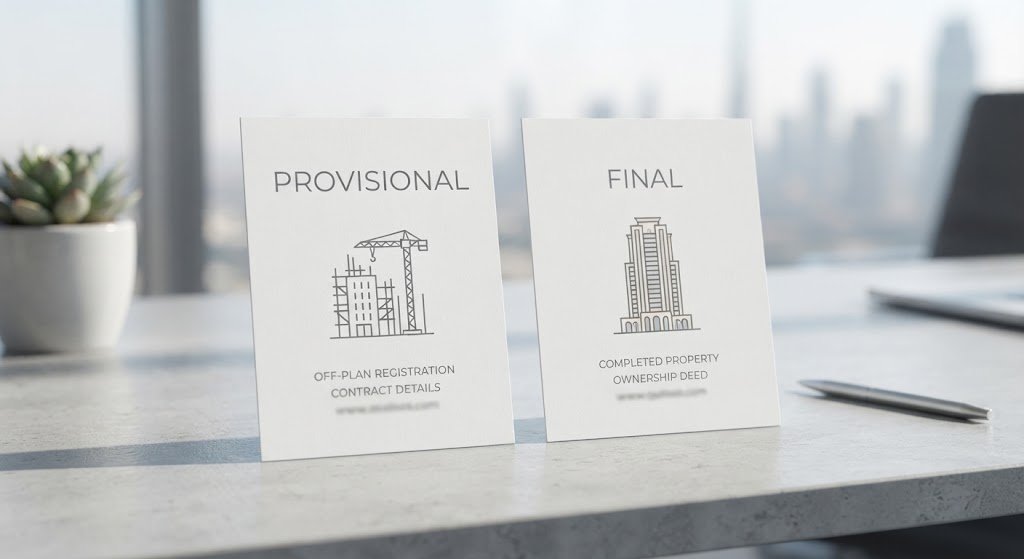
The Oqood certificate is a provisional document. It is not a title deed. It remains in force until the developer completes the project and the property is entered in the main Property Register. Under Article 8 of Law No. 13 of 2008, after receiving a completion certificate, the developer must enter the project in the main Property Register, and units are transferred into the buyer's name once the buyer has met their contractual obligations (primarily, completing payment).
At that point, the Oqood registration converts to a full title deed, and the provisional e-certificate is superseded. You can learn more about the title deed process for Australian buyers in Dubai in our dedicated guide.
What Oqood Registration Protects You Against
Legal void without it
The strongest protection Oqood gives you is simple: without it, your purchase does not exist in law. Article 3(1) of Law No. 13 of 2008 is unambiguous — an off-plan disposition that is not entered in the Interim Property Register is void. If a developer were to sell the same unit to two buyers and only registered one of them through Oqood, the registered buyer would have the legal claim. The unregistered buyer would not.
This is not a theoretical risk. Oqood registration was introduced specifically because the absence of a formal register created buyer vulnerability in Dubai's earlier off-plan market.
The right to sell, mortgage, or transfer
Once your purchase is registered, Article 6 of Law No. 13 of 2008 gives you rights over the unit that go beyond just occupying it after completion. A registered off-plan unit may be sold, mortgaged, or otherwise disposed of. This means you can sell your off-plan unit on the secondary market before the building is complete, using your Oqood certificate as proof of ownership. This is how the Dubai secondary off-plan market operates.
To understand how your funds are protected during the construction period, read our guide on how off-plan escrow protection works in Dubai.
DLD dispute access
Under Article 13 of Law No. 13 of 2008, if the DLD finds that a developer has violated the law, it must refer the matter to competent authorities for investigation. Under Article 14 of Executive Council Resolution No. 6 of 2010, the DLD may also attempt conciliation between a buyer and a developer. A settlement reached through this process must be in writing and approved by the DLD to become binding.
Having a valid Oqood registration puts you inside the DLD's jurisdiction for these processes. An unregistered buyer has no formal standing to use them.
Developer default and buyer default rules
Article 11 of Law No. 13 of 2008 sets out what happens if a buyer defaults on their payment obligations. The developer must notify the DLD of the breach. The DLD then gives the buyer 30 days' notice. If the buyer still does not comply, the developer may cancel the contract and retain up to 30% of payments made.
This is important to understand in both directions. The 30-day notice requirement and the 30% cap are protections for the buyer — a developer cannot simply cancel your contract and keep all your money without going through the DLD's process.
Oqood and the Escrow Account
The connection
Dubai law requires developers to hold off-plan buyer payments in a RERA-registered escrow account, separate from the developer's own funds. The Oqood registration and the escrow account work together: the DLD's eService page confirms that one of the payment methods for Oqood fees is deduction from the project's escrow account, which means the Oqood registration is tied directly to the project's financial structure.
This matters for Australian buyers because it means your registration is connected to a protected pool of funds, not just a paper record. For a full explanation of how escrow accounts protect off-plan buyers, read our guide on how off-plan escrow protection works in Dubai.
Oqood vs Title Deed: The Key Difference
Australian buyers sometimes confuse the Oqood certificate with the title deed, or assume they are the same thing. They are not.
The following table explains the differences between the two, based on their positions in Dubai property law.
|
Feature |
Oqood Certificate |
Title Deed |
|
Register |
Interim Property Register (DLD) |
Main Property Register (DLD) |
|
Stage |
Off-plan, before completion |
After project completion |
|
Legal basis |
Law No. 13 of 2008 |
Dubai Law No. 7 of 2006 |
|
Issued by |
DLD, via Oqood portal |
DLD Trustee Centre |
|
Format |
E-certificate sent by email |
Physical and digital document |
|
Enables resale |
Yes, on secondary off-plan market |
Yes, as a completed property |
|
Enables mortgage |
Yes, subject to lender terms |
Yes |
The Oqood certificate is not a lesser document. It is the correct document for the stage of the transaction. Once the project completes, the transition from Oqood to title deed is part of the normal completion process.
What to Do as an Australian Buyer
Before you sign
Confirm that the developer you are buying from is registered with RERA and that the project has all required approvals under Article 4 of Law No. 13 of 2008. A developer cannot sell off-plan until they have taken possession of the land and obtained the required project approvals. Contracts signed before those approvals are in place are null under Article 10 of the same law.
Ask your developer to confirm in writing that they will register the Oqood within 90 days of contract signing and that you will receive the e-certificate by email from the DLD.
After you sign
Track the date you signed your sale and purchase agreement. If you have not received your Oqood e-certificate within a reasonable period, follow up with the developer. The DLD does not send reminders, and the 90-day clock runs from your signing date.
Once you receive the certificate, save it in multiple secure locations. You will need it if you sell before completion, if you refinance, or when your title deed is being processed at project handover.
For your Australian tax records
Your Oqood certificate establishes the acquisition date of your Dubai property for Australian Capital Gains Tax purposes. The ATO treats the date you entered into the contract as the acquisition date, not the date you received the title deed. Keep the certificate alongside your SPA and payment records as part of your Australian tax file. Learn more about how Australian tax rules apply to Dubai property in our dedicated ATO guide.
Ready to Buy Off-Plan in Dubai?
Understanding Oqood is one part of the picture. Choosing the right project, developer, and payment structure is the other. At Dubai Property Expo, we work with Australian buyers at every stage — from selecting an RERA-registered developer through to tracking your Oqood certificate and planning for handover.
Read our full guide on how to buy property in Dubai as an Australian, see the off-plan projects available now, and learn what documents you need at every stage of the purchase.
Talk to the team at Dubai Property Expo to start your journey with a clear plan.
Frequently Asked Questions
What is an Oqood certificate in Dubai?
An Oqood certificate is the provisional registration e-certificate issued by the Dubai Land Department when an off-plan sale is recorded in the Interim Property Register. It is your legal proof of ownership of an off-plan unit until the developer completes the project and the property is transferred to the main Property Register with a full title deed.
Who registers Oqood in Dubai — the buyer or the developer?
The developer registers the Oqood through the DLD's Oqood portal (Real Estate Developers Portal). The buyer does not apply directly. Once registration is complete, the DLD sends the Oqood e-certificate to the purchaser by email.
How long does Oqood registration take in Dubai?
The DLD's eService page states that the service time is measured in business days but does not give a fixed number. The legal requirement is that the sale and purchase contract must be registered in the Interim Property Register within 90 days of the signing date, as confirmed on the DLD eService page.
What happens if a developer does not register Oqood in Dubai?
Under Article 3(1) of Dubai Law No. 13 of 2008, any off-plan sale that is not recorded in the Interim Property Register is void. An unregistered transaction gives the buyer no legal standing. If a developer fails to register within 90 days of contract signing, the buyer should contact the DLD directly.
Can I sell my off-plan property before the Oqood becomes a title deed?
Yes. Under Article 6 of Dubai Law No. 13 of 2008, a registered off-plan unit may be sold, mortgaged, or otherwise disposed of. Your Oqood certificate is what you use to prove ownership and proceed with a resale on the secondary market before project completion.