Quick Answer:
- Rental yields: Dubai delivers 6 to 9% gross versus 3 to 3.6% across Australian capital cities
- Tax position: Dubai charges zero income and capital gains tax at source on all rental income
- Entry costs: Dubai freehold apartments start from AUD 205,000 with interest-free payment plans
- Capital growth: Dubai residential values rose 19.8% year-on-year as of December 2025
- Golden Visa: Purchasing above AED 2 million qualifies for 10-year UAE family residency
Australian investors have never faced a starker choice than in 2026. Domestic property delivers compressed yields, rising holding costs, and tightening regulation. Dubai sits at the opposite end of every single metric that matters to income-focused investors.
Sydney property prices remain among the highest in the world, rental yields across much of Australia often sit between 2% and 3%, and investors are increasingly looking offshore for better returns. Dubai, with its modern infrastructure, tax advantages, and aggressive development pipeline, has become one of the most talked-about international investment markets for Australians.
This guide delivers a direct, data-driven comparison of dubai vs australian property across five decision-making dimensions: rental yields, tax treatment, entry costs, capital growth, and long-term risk. By the end, you will know exactly where your capital works harder in 2026.
Rental Yield Comparison: Full Breakdown
Rental yield is the most immediate and measurable difference in the dubai vs australian property comparison. No other metric separates the two markets as sharply or as consistently.
Australian Yields in 2026
CoreLogic’s national housing data confirms gross rental yields across Australian capital cities in 2026:
| City | Gross Rental Yield | Median Entry Price |
| Sydney | 3.1% | AUD 1,400,000+ |
| Melbourne | 3.6% | AUD 983,000 |
| Brisbane | 4.3% | AUD 850,000+ |
| Perth | 4.8% | AUD 720,000+ |
| Adelaide | 4.5% | AUD 680,000+ |
After land tax, property management, council rates, and maintenance, net yields in Australian capital cities compress to 2% to 3.5% in most cases. For investors relying on property for retirement income, these numbers are structurally insufficient.
Dubai Yields in 2026
As of April 2026, the average rental yield for new contracts in Dubai stood at 6.98%, while renewal contracts averaged 6.40%. Dubai’s average gross rental yield in 2026 sits between 6% and 8%, with mid-market apartments outperforming premium addresses. JVC leads at 8.5 to 9.5% gross.
| Zone | Gross Yield | Entry Price AED | Entry Price AUD |
| JVC | 8.5 to 9.5% | 600,000 to 800,000 | AUD 245,000 to 325,000 |
| Arjan | 8 to 9% | 550,000 to 750,000 | AUD 225,000 to 306,000 |
| Business Bay | 5.5 to 7.6% | 900,000 to 1,500,000 | AUD 368,000 to 612,000 |
| Dubai Marina | 5.5 to 7.2% | 900,000 to 1,400,000 | AUD 368,000 to 571,000 |
| Downtown Dubai | 4 to 6% | 1,500,000+ | AUD 612,000+ |
Even after deducting service charges and management fees, net yields in Dubai typically range between 5.5 and 7%. For investors focused on rental returns, this difference is substantial. The rental demand among expatriates and professionals ensures stable income potential.
The Net Yield Verdict
When comparing dubai vs australian property on net yield, Dubai wins comprehensively at every equivalent entry price point. A JVC one-bedroom apartment netting 6.5% after costs outperforms the gross yield of any Sydney or Melbourne investment property by a margin that compounds significantly over a 5 to 10 year hold.
The net yield verdict is unambiguous: for income-focused Australian investors, Dubai delivers stronger cash flow at a lower entry price than any comparable domestic option in 2026.
In Australia, average gross yields for apartments in most cities sit around 3 to 4%. In premium suburbs, the yield can drop even lower, making it difficult to generate meaningful cash flow. Dubai tells a completely different story for Australian investors.

Tax Treatment: A Critical Difference
Tax treatment is the second decisive variable in the dubai vs australian property comparison. The structural advantage of Dubai’s zero-tax environment fundamentally reshapes the net return calculation for Australian investors.
Dubai Tax Position
Dubai applies zero rental income tax, zero capital gains tax, zero annual property tax, and zero stamp duty. The full tax comparison relevant to Australian investors includes:
- Rental income tax: Zero in UAE versus up to 47% marginal rate in Australia
- Capital gains tax: Zero in UAE versus Australian CGT with 50% discount after 12 months
- Land tax: Zero in UAE versus state-based annual charge in most Australian states
- Stamp duty: Zero for ongoing ownership versus no equivalent ongoing charge in Australia
- Annual property tax: Zero in UAE versus council rates and land tax in Australia
Every dirham your Dubai tenant pays reaches your account without any UAE deduction. The gross yield and your pre-Australian-tax yield are identical in Dubai, which is a structural advantage domestic property can never replicate.
Australian Tax Obligations
Australian tax residents must declare global income to the ATO, including overseas property gains. Proper structuring before purchase is crucial. Currency planning is essential, especially for off-plan purchases with the AED pegged to the USD.
Australian investors must report Dubai rental income annually to the ATO as foreign income. Because the UAE charges zero tax at source, double taxation does not apply. You pay Australian income tax on gross Dubai rent, but receive 100% of what the property earns before that calculation.
The Post-Tax Comparison
Even after Australian income tax at the 37% marginal rate is applied to an 8% Dubai gross yield, the after-tax return sits at approximately 5.1%. That still outperforms the gross yield of most Sydney and Melbourne investment properties before any local costs are subtracted. The tax math continues to favor dubai vs australian property at most income levels.
The key point in the Dubai vs Australian property comparison is that gross yield is only the starting point. Net return after service charges, vacancy, and management costs matters most. The UAE tax position is 0% personal income tax for most individual investors on the UAE side.
Entry Costs and Barriers
The entry cost comparison in the dubai vs australian property debate is where most Australian investors receive their biggest surprise. Dubai is not the expensive premium market its luxury image suggests at the entry level.
Australian Entry Costs
The full cost of entering the Australian property market in 2026 at a comparable income-producing level:
| Cost Item | Amount |
| Purchase price (Sydney 1-bed) | AUD 750,000 to 1,200,000 |
| Stamp duty (NSW) | AUD 30,000 to 50,000+ |
| Buyer’s agent fee | AUD 10,000 to 20,000 |
| Building and pest inspection | AUD 500 to 1,500 |
| Conveyancing | AUD 1,500 to 3,000 |
| Total additional costs | 4 to 7% above purchase price |
| Land tax (ongoing, NSW) | AUD 5,000 to 15,000+ annually |
The effective entry barrier for a yield-generating property in a Sydney or Melbourne suburb now starts at AUD 750,000 to AUD 1,200,000 after all acquisition costs are included.
Dubai Entry Costs
The full cost of entering Dubai’s freehold market at equivalent or better yield performance:
| Cost Item | Amount |
| Purchase price (JVC 1-bed) | AED 600,000 to 800,000 (AUD 245,000 to 325,000) |
| DLD transfer fee | 4% of purchase price |
| DLD admin fee | AED 4,000 to 5,000 |
| Trustee office fee | AED 4,000 |
| Agent commission (off-plan) | Zero for direct developer purchase |
| Total additional costs | 5 to 7% above purchase price |
| Land tax (ongoing) | Zero |
With interest-free developer payment plans requiring 10% upfront, an Australian investor can secure a Dubai investment property for an initial outlay of AUD 25,000 to 35,000 in top-yielding zones. That comparison with AUD 750,000 minimum Sydney entry is the core accessibility advantage in the dubai vs australian property debate.
Off-Plan Payment Advantage
Dubai’s off-plan market offers a structural advantage that no Australian developer provides. Interest-free milestone payment plans spread the purchase cost across 3 to 5 years with no mortgage product required. A JVC off-plan purchase at AED 700,000 can be secured with AED 70,000 (approximately AUD 28,600) upfront and the balance paid in staged installments while the building completes.
A one-bedroom apartment in a good location in a major Australian city can easily run to over AUD 750,000. For many investors, this represents a significant barrier to entry. Meanwhile, investors can access brand new one or two-bedroom apartments in Dubai freehold areas at substantially lower price points.
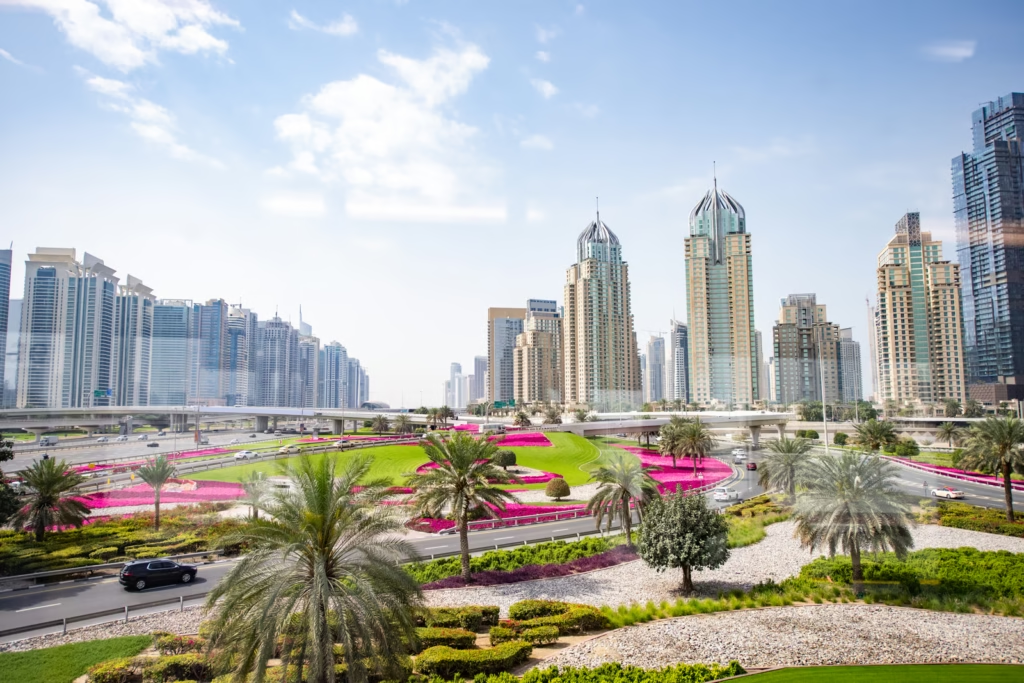
Capital Growth Comparison
Capital growth is the dimension of the dubai vs australian property comparison where investors often assume Australia wins. The 2026 data challenges that assumption directly.
Dubai Capital Growth
Dubai’s average gross rental yield in 2026 sits between 6% and 8%, and citywide weighted-average residential values reached AED 1,689 per square foot as of December 2025, up 19.8% year-on-year, reflecting consistent capital appreciation across established freehold zones.
Dubai capital growth by zone in 2026 reflects infrastructure investment, population growth, and sustained global demand:
- Dubai South: 15 to 29% annual appreciation in surrounding corridors near Al Maktoum Airport
- Dubai Creek Harbour: Strong capital appreciation driven by Emaar development pipeline
- JVC: Consistent 10 to 15% annual appreciation as community infrastructure matures
- Downtown Dubai: Steady premium appreciation driven by constrained supply and global demand
- Business Bay: Transitioning from mid-market to luxury extension, driving repricing above market average
Capital growth varies across Dubai, with each community influenced by different economic and infrastructure drivers. Comparing these growth trends helps investors identify areas with the strongest long-term appreciation potential.
Australian Capital Growth
CoreLogic data confirms mixed capital growth across Australian markets in 2026. Sydney quarterly values declined 0.2% in Q1 2026. Melbourne grew 0.1% in January. Brisbane and Perth have performed better but face affordability ceiling constraints as prices have already risen significantly since 2020.
The capital growth comparison in dubai vs australian property is now closer than most Australian investors expect. Dubai’s 19.8% year-on-year residential value growth in late 2025 significantly outpaced every major Australian capital city market on a like-for-like basis.
Risk and Liquidity Factors
Both markets carry risk. Dubai risks include off-plan delivery delays, developer concentration, and AUD-USD currency exposure. Australian risks include tightening rental legislation, land tax expansion, and affordability ceiling constraints on capital growth. Neither market is risk-free. The risk profile of dubai vs australian property is different, not necessarily higher on the Dubai side, provided proper developer verification is completed before commitment.
Currency diversification is another factor attracting Australian buyers. The UAE Dirham is pegged to the US dollar, meaning that if the Australian dollar weakens against the USD, the value of the Dubai asset effectively increases when converted back to Australian currency.
Ready to Compare Dubai vs Australian Property Live?
The dubai vs australian property comparison resolves clearly in 2026 across all five dimensions reviewed. Dubai delivers stronger net yields at lower entry points, zero local tax at source, documented capital growth, and the Golden Visa residency pathway that no Australian investment can provide.
Dubai investment offers higher rental yields, lower capital requirements, and tax breaks that make it a genuinely competitive choice for Australian investors who have already maximized what the domestic market can deliver.
.Register your free seat at the Dubai Property Expo Australia today and make the Dubai vs Australian property decision with real data, real developers, and real pricing.
Frequently Asked Questions
Is Dubai property a better investment than Australian property in 2026?
For income-focused investors, Dubai delivers materially stronger results across the key metrics in 2026. Gross yields of 6 to 9% compare to 3 to 3.6% in Australian capital cities. Entry prices in high-yield Dubai zones start from AUD 245,000 versus AUD 750,000 minimum in comparable Australian markets. Zero UAE tax at source versus Australian marginal rate taxation further widens the net return gap. Capital growth has also been stronger in Dubai on a year-on-year basis, with citywide residential values rising 19.8% in the 12 months to December 2025.
How do Dubai rental yields compare to Sydney and Melbourne in 2026?
Sydney gross yields average 3.1% and Melbourne 3.6% as of early 2026 according to CoreLogic. Dubai’s average new contract yield stands at 6.98% citywide, with JVC reaching 8.5 to 9.5% gross. After all holding costs, Dubai net yields typically run 5.5 to 7%, which still significantly outperforms gross Australian capital city yields at comparable entry points. The yield gap is structural and reflects fundamental differences in tax treatment, entry pricing, and tenant demand demographics between the two markets.
Do I pay tax on Dubai rental income as an Australian investor?
Dubai charges zero rental income tax at source. Australian residents must declare all Dubai rental income to the ATO as foreign income annually. Because no UAE tax applies at source, double taxation does not occur. You pay Australian income tax at your marginal rate on the gross rent received, but receive 100% of what the Dubai property earns before that calculation. The 50% CGT discount applies to capital gains on properties held for more than 12 months. Consult a qualified Australian accountant with overseas property experience before finalizing any purchase structure.
What are the entry costs for Dubai property versus Australian property?
Australian property in Sydney requires AUD 750,000 to AUD 1,200,000 plus stamp duty of AUD 30,000 to 50,000 for a comparable income-producing asset. Dubai freehold apartments in high-yield zones like JVC start from AUD 245,000 with a 4% DLD transfer fee and no ongoing land tax. Off-plan developer payment plans require as little as 10% upfront, meaning AUD 25,000 to 35,000 can secure a Dubai property in a zone delivering 8%+ gross yields. The total acquisition cost as a percentage of purchase price is broadly comparable between the two markets, but the absolute entry point is dramatically lower in Dubai.
What risks should I consider when comparing Dubai vs Australian property?
Dubai-specific risks include off-plan delivery delays, AUD-USD currency exposure on staged payment plans, developer selection risk, and ATO reporting obligations that must be managed carefully. Australian-specific risks in 2026 include tightening rental legislation, expanding land tax across multiple states, affordability ceiling constraints limiting capital growth, and compressed yields that make neutral or positive cash flow difficult without significant equity. Both markets carry genuine risks. The key difference is that Dubai risks are largely manageable through developer verification and proper tax structuring, while Australian market structural challenges are regulatory and demographic in nature